
Decks in Southern California: cost, materials and what actually wears out
What drives deck cost in Los Angeles, how wood and composite really behave in intense sun, and which parts of a deck fail first.
Verify a California contractor in three steps before signing. Check the license number on the CSLB website for active status, the correct classification for your work, and any disciplinary history. Confirm workers compensation and general liability insurance directly with the insurer or via a certificate naming you. Then read the contract for defined scope, a milestone payment schedule, stated allowances and exclusions, and a written change-order procedure — and know that California limits the down payment on home improvement contracts.
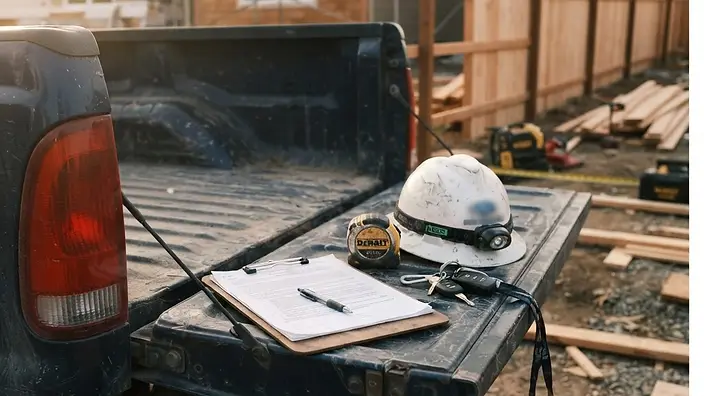 Editorial illustration — not a Fency Builders project. License, insurance, references and contract terms should be checked before signing.
Every project depends on the licensed parties, written scope, insurance, approvals, and recordkeeping. Basic verification can be completed before signing.
Here is the entire list, in the order it should happen.
A license number printed on a truck is not verification. Take the number from the written proposal and look it up on the Contractors State License Board website. Confirm four things:
Our own record is public for exactly this reason: Fency Builders Inc, CSLB License #1104099, and we encourage clients to look it up before signing anything — with us or anyone else.
Ask for verification of workers compensation, where employees are involved, and general liability. The meaningful version comes from the insurer or agent, or a certificate issued naming you — not a photocopy from a folder, which proves only that a policy existed on the day it was printed.
The reason this matters is simple: if an uninsured worker is injured on your property, the exposure can land on you.
The written agreement should identify the proper permit applicant and responsible licensee for the approved scope. If an owner is asked to act as owner-builder, review CSLB's official explanation of the legal and financial responsibilities before accepting that role.
The corollary: a contractor who tells you no permit is needed without checking your parcel is guessing. Which requirements apply depends on your jurisdiction, your zone and your grade — the process is set out in fence and wall permits in Los Angeles.
Two bids far apart are rarely the same work at different prices. They are usually different work. The gaps are almost always in the parts you cannot see afterwards:
Ask each bidder to state those items. The answers tell you what you are actually comparing.
A contractor who welcomes the license lookup, provides insurance verification without hesitation, writes a scope you can read and understand, prices the invisible work openly, identifies the proper permit applicant and responsible licensee, and puts changes in writing.
None of that is dramatic. It simply removes the ways a project goes wrong. Our reviews and completed projects are published for the same purpose the license record is — so the claims can be checked rather than taken on trust.
Reviewed September 1, 2026. Rules and product requirements can change; confirm the parcel, approved documents, and selected system before relying on this guide.
 Modern stucco and stone facade at dusk
Look the license number up on the Contractors State License Board website. Confirm it is active, that the business name matches who you are contracting with, that the classification covers your type of work, and review the bond and workers compensation status plus any disciplinary history. Take the number from the written proposal, not from an advertisement.
Licensed contractors are required to carry a bond, and workers compensation is required where employees are involved. General liability is not universally mandated by the license itself but is standard practice for legitimate operators, and you should confirm it. Ask for verification directly from the insurer or a certificate issued to you.
California limits the down payment on home improvement contracts, and the remainder should follow a schedule tied to completed work. A demand for a large percentage up front, or pressure to pay in cash, runs against both the rule and normal practice — treat it as a signal, not a negotiation.
No. A licensed contractor should pull the permit under their own license. When you pull it as an owner-builder you take on the legal responsibility for the work and its compliance. A request to do so usually means the contractor cannot pull it themselves, which is the more important thing you have learned.
A specific scope of work, the total price, a payment schedule tied to milestones, start and completion dates, license number, allowances stated with amounts, explicit exclusions, a written change-order procedure, warranty terms for labor and material, and who is responsible for permits. Verbal additions are not enforceable in practice.
Pressure to decide immediately, a large cash deposit, no written contract or a one-line contract, a license number that does not match the business name, refusal to provide insurance verification, an offer to skip the permit, and door-to-door solicitation with leftover material from another job. Any one of them is enough to stop.
Tell us the property, the scope, and what matters most.
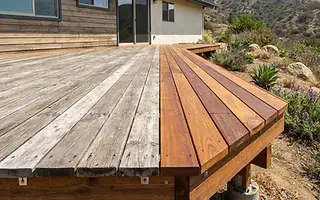 Outdoor LivingEditorial illustration
What drives deck cost in Los Angeles, how wood and composite really behave in intense sun, and which parts of a deck fail first.
 Gates & AccessEditorial illustration
Why automatic gates fail, how to tell a mechanical problem from an operator problem, the safety devices that must work, and a maintenance routine that prevents most calls.
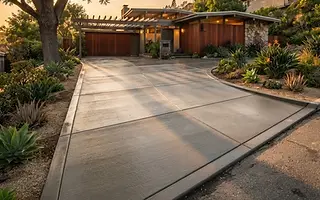 HardscapeEditorial illustration
Base, thickness, joints and drainage decide whether a driveway or patio lasts twenty years or cracks in three — plus how concrete and pavers really compare.