
Decks in Southern California: cost, materials and what actually wears out
What drives deck cost in Los Angeles, how wood and composite really behave in intense sun, and which parts of a deck fail first.
Fence pricing in Los Angeles is driven by site conditions — soil type, slope, access, height, demolition, and gate complexity — far more than by the panel material you select. Because Southern California variables like expansive clay soils, Santa Ana wind loads, coastal salt air, and hillside terrain vary dramatically from one property to the next, no reliable per-foot figure exists without a site visit. Understanding the five structural and site cost drivers helps you evaluate competing bids on an apples-to-apples basis rather than on total price alone.
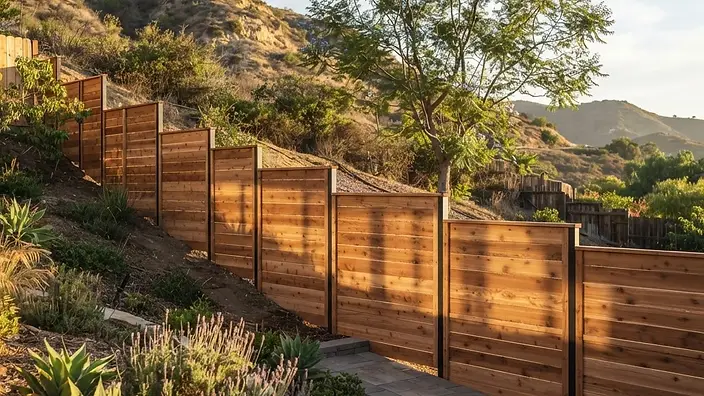 Editorial illustration — not a Fency Builders project. Slope, soil and access move a fence budget more than the board you pick.
Budgeting a new fence in Los Angeles is not a straightforward exercise, and any contractor who quotes a per-foot price before walking your property is working from assumptions that may have nothing to do with your site. Southern California throws a long list of variables at every fence project — clay soils that shift with moisture, coastal salt air, Santa Ana wind loads, hillside terrain, seismic movement, intense UV exposure, wildfire defensible-space requirements, and a rain pattern that is long dry then briefly intense. Understanding what actually drives the investment helps you evaluate proposals clearly and make decisions you will not regret in year five.
Fence work is site-driven, not catalog-driven. Two neighboring homes on the same street can produce dramatically different scopes simply because one sits on a level lot with sandy soil and direct side-yard access, while the other sits on a terraced hillside with expansive clay, a retaining wall transition, and a six-foot gate clearance problem. The panel you choose — the part visible from the street — is actually one of the smaller variables. What drives labor and structural cost is everything underneath and behind that panel: soil conditions, post depth, footing diameter, slope geometry, demolition, and access constraints. A quote delivered over the phone before anyone has walked the property is a number shaped by hope, not by your specific project.
1. Material selection. Pressure-treated pine may carry a lower initial material cost in some proposals; product grade, treatment, framing, exposure, and maintenance still control suitability. Cedar and redwood resist moisture and insects naturally, weather more gracefully in coastal microclimates, and carry a corresponding price difference. Vinyl and composite systems have different upfront costs and routine maintenance requirements; compare the named product, warranty, cleaning, repair options, and supporting frame. Tube steel and aluminum can support open profiles and heavier gate assemblies when the frame, connections, coatings, footings, and exposure are designed as one system. None of these is universally "the right choice"; the right choice depends on your exposure, your maintenance tolerance, and your HOA if one applies.
2. Height and structural loading. Height affects far more than the square footage of material. A taller fence in a Santa Ana wind corridor requires larger-diameter posts, deeper footings, and heavier framing to resist lateral load. Confirm with your local building department what height limits and permit thresholds apply to your zone — they vary by municipality, by property zone, and by whether the fence sits on a front yard, side yard, or rear property line.
3. Demolition and existing conditions. Pulling out an old chain-link fence is fast work. Removing a deteriorating masonry wall, breaking out concrete footings, or clearing a decade of overgrown bougainvillea is a real labor and disposal line item. On hillside lots, concrete spoils cannot always be loaded directly into a truck — they move by hand or by equipment that may require separate staging. Price this honestly before comparing bids.
4. Slope, soil, and access. Los Angeles hillside lots are their own category. Stepped panels, raked panels, and custom-cut infill all add layout time. Some Los Angeles parcels contain expansive or otherwise challenging soil. Footing design must follow the observed site condition and any applicable approved detail or engineering. If materials must be hand-carried through a home, down a slope, or through a narrow side yard, labor increases accordingly. Good contractors account for this on-site; low bidders often do not.
5. Gates. A walk gate is a defined, manageable scope. A wide driveway gate — especially an automated one — is a separate project nested inside the fence project. It involves its own structural posts (set deeper, with larger footings to handle cantilever or swing load), an operator unit, safety-reverse devices, loop detectors or access hardware, and a conduit run to a power source. If that conduit run requires trenching across a driveway or involves a licensed electrician, that coordination belongs in the scope and the timeline from the start.
The panel is what visitors see. The post, the footing, and the hardware are what determine whether that panel is still plumb and tight in year eight after two wet winters, a dry cycle that contracts the clay, and three seasons of Santa Ana gusts. One avoidable mismatch is choosing a premium panel while leaving post, footing, or connection specifications undefined. That combination can look finished initially while leaving a weaker supporting system. When comparing proposals, the structural specification matters more than the total line. Ask every bidder for post material and dimension, post spacing, footing depth and diameter, panel or picket detail, and hardware type and finish. When those five inputs match across proposals, price differences become genuinely meaningful.
This is one of the most common questions homeowners ask, and the honest answer is: it depends, and you need to confirm with your local building department before work begins. Permit requirements vary based on fence height, material type, whether the fence is freestanding or attached, your zoning classification, and your specific municipality — the City of Los Angeles, unincorporated LA County, and independent cities like Pasadena, Burbank, or Santa Monica each maintain their own codes. Hillside zones and Very High Fire Hazard Severity Zones add additional layers. Wildfire defensible-space regulations may also influence material choices and setbacks, particularly if your property backs against open space or hillside brush. A contractor who tells you categorically that your project "never needs a permit" without having reviewed your specific address and scope is skipping a step that protects you.
Contractors who work only in mild climates sometimes underspec for what Los Angeles actually delivers. Coastal properties from Malibu through the South Bay deal with salt-air corrosion that accelerates hardware failure on standard zinc hardware — hardware and coatings should be selected from current manufacturer specifications for the measured coastal exposure. UV intensity at Southern California latitudes degrades wood finishes faster than homeowners expect; a maintenance plan for staining or sealing is part of the real total cost of ownership. Structural details and footing design must follow the applicable approved requirements for the site. And the rain pattern — a long dry season followed by brief, intense precipitation — means drainage at fence posts matters. A post footing that traps standing water during the rainy season accelerates rot in wood species and rust in uncoated steel regardless of how well the above-grade material was specified.
The clearest path to a useful estimate is a prepared homeowner. Know where your property line sits — a survey, your title report, or a recorded plot map is more reliable than a presumed line based on landscaping. Mark or flag where irrigation lines, gas lines, and electrical conduit run near the fence path, because utility strikes during post excavation are real events with real consequences. Decide your priority order before the conversation starts: is this fence primarily about privacy, security, appearance, longevity, fire-resistance, or some weighted combination? That ranking changes the recommendation more than the budget does, and a contractor who asks about it before proposing materials is doing the job correctly.
A professional estimate is not a price-per-foot multiplied by your footage. It is a written document that identifies the fence run by location, specifies post material and dimension, states footing depth and diameter, names the panel or infill product, lists hardware finish, describes the demolition scope, notes who is responsible for permits and inspections, and defines what happens if unexpected conditions — a buried footing, a utility conflict, a soil condition — are discovered during excavation. That level of specificity is what makes a proposal comparable to a competing proposal and what protects both parties when the work begins. If a proposal does not include it, ask for it in writing before signing anything.
Permit and licensing facts should be confirmed at source: LADBS for City of Los Angeles properties, Los Angeles County Public Works for unincorporated areas, your own city's building department elsewhere, and CSLB to verify a contractor's licence.
Reviewed and current as of September 1, 2026. Building codes and zoning overlays change; confirm with the authority for your address.
Reviewed September 1, 2026. Rules and product requirements can change; confirm the parcel, approved documents, and selected system before relying on this guide.
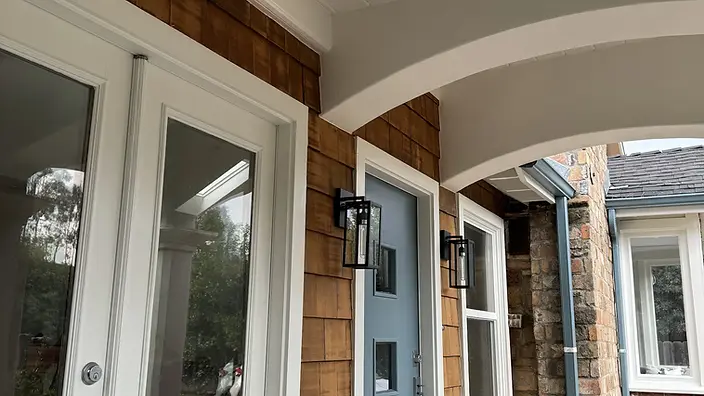 Horizontal wood slat privacy fence with metal posts
Permit requirements in Los Angeles depend on fence height, material, zoning classification, and which municipality your property falls under — the City of LA, unincorporated LA County, and independent cities like Pasadena or Santa Monica each have their own rules. Properties in hillside zones or Very High Fire Hazard Severity Zones face additional requirements. Always confirm the current thresholds with your local building department before work begins, because a contractor who skips this step is transferring that risk to you.
In Los Angeles, expansive clay soils shrink and swell seasonally with moisture changes, which can heave or tilt shallow footings over time. A footing needs to reach below the active zone of that clay movement to remain stable, and the required depth varies by soil report and local conditions. Your contractor should assess soil conditions on-site and confirm footing requirements with the local building department rather than defaulting to a one-size depth.
Salt air accelerates corrosion on standard zinc hardware and degrades certain finishes faster than inland conditions, so material and hardware choices matter more in coastal zones from Malibu through the South Bay. Marine-grade or stainless-steel fasteners and hardware are the baseline, not an upgrade, in those microclimates. Aluminum, vinyl, and composite systems resist salt-air corrosion more reliably than untreated wood or standard-coated steel, though each involves trade-offs in appearance and cost that are worth evaluating with your contractor.
A phone quote is built on assumptions about your property that may have nothing to do with your actual site — soil conditions, slope, access, demolition, and utility conflicts are all unknowns until someone walks the property. Contractors who quote low remotely often adjust the price once they arrive, or they hold the number by reducing post size, footing depth, or hardware quality in ways that are not obvious until the fence starts to fail. Compare bids only after each contractor has visited the site and provided a written specification.
A complete bid should state post material and dimension, post spacing, footing depth and diameter, the specific panel or picket product, hardware type and finish, the full demolition scope, and who is responsible for pulling permits and meeting the inspector. It should also describe what happens if an unexpected condition — a buried footing, a utility line, or a soil problem — is found during excavation. If any of those elements are missing from a proposal, ask for them in writing before signing, because vague bids produce disputes after work begins.
Share the approximate fence length, number and type of gates, preferred material, city, and photos of the full run, access, and ground or existing posts. Those inputs let us define the scope before discussing an estimate.
 Outdoor LivingEditorial illustration
What drives deck cost in Los Angeles, how wood and composite really behave in intense sun, and which parts of a deck fail first.
 Gates & AccessEditorial illustration
Why automatic gates fail, how to tell a mechanical problem from an operator problem, the safety devices that must work, and a maintenance routine that prevents most calls.
 PermitsEditorial illustration
How fence and wall height limits are structured across Los Angeles jurisdictions, what triggers a permit, and the exact steps to confirm the rule for your address.