
Decks in Southern California: cost, materials and what actually wears out
What drives deck cost in Los Angeles, how wood and composite really behave in intense sun, and which parts of a deck fail first.
Replace a roof when the failure is systemic — widespread granule loss and brittle, curling shingles, underlayment at the end of its life, multiple leaks in different areas, or damaged sheathing. Repair when the failure is local and the rest of the roof is sound, which most often means flashing at a penetration, valley or wall, a small storm-damaged area, or a failed sealant. In Los Angeles the underlayment and flashing usually age out before the visible surface looks finished, so a roof can leak while still appearing acceptable from the street.
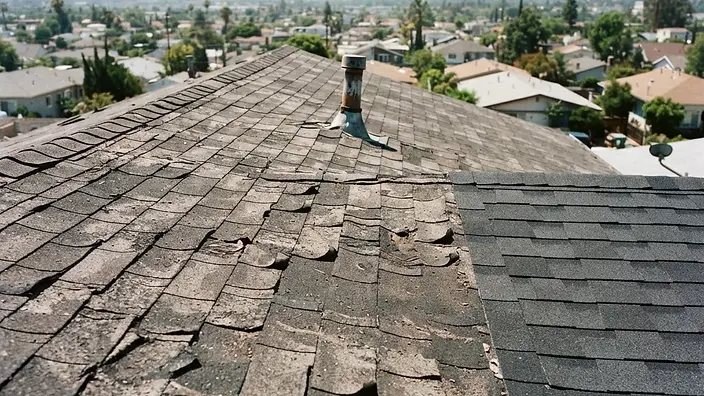 Editorial illustration — not a Fency Builders project. Visible roofing and the weather-protection layers below it can age differently.
Roofs in Los Angeles fail differently than roofs elsewhere. Freeze-thaw and snow loads are generally less dominant here than heat, ultraviolet exposure, wind, and seasonal rain, but the actual site and adopted code still control. What there is instead is relentless ultraviolet exposure, daily heat cycling that expands and contracts every material on the roof, months of dry weather that dries out sealants and mastic, and then a winter that delivers a year of rain in a handful of storms.
A roof can look tolerable from the street while concealed water-management components — underlayment, flashing and sealant — may be deteriorated. Their condition depends on the roof system, installation, exposure, maintenance and inspection findings.
The visible material sheds most water. The system beneath it handles the rest:
A complete roof assessment addresses all five. A quote that names only a shingle brand has skipped the four items that decide how long the work lasts.
Tile roofs deserve a specific note. Some concrete or clay tile may remain serviceable after the underlayment or flashing needs work, but condition varies by product, installation and exposure. A lift-and-relay may be evaluated when the existing tile is suitable for reuse and the approved system, code and manufacturer requirements allow it; the inspection and written scope decide whether that approach is appropriate.
Water travels. A stain on a bedroom ceiling can originate several feet away, at a flashing detail that lets water run along a rafter before it drops. Chasing the stain instead of the entry point is why some leaks get "repaired" three times.
A competent diagnosis works from the attic side where accessible, follows the path uphill, and inspects the roof at the suspected origin — rather than smearing sealant on the nearest visible imperfection.
Substantial parts of our service area sit in Very High Fire Hazard Severity Zones — Altadena, West Hills, Porter Ranch among them. Roofing assemblies there face fire-rating requirements, and details such as ember-resistant vents and enclosed eaves come into play. The parcel's fire-zone status, adopted code, approved assembly, and listed products must be confirmed before material selection.
A roofing proposal should state: tear-off and disposal, deck inspection with a defined allowance for replacing damaged sheathing, the underlayment specified by name, the condition and disposition of each flashing detail, ventilation, the visible roofing material, permit responsibility, and labor and material warranty terms separately.
Each flashing detail should be inspected and its reuse or replacement stated in writing. Reusing aged, damaged or incompatible flashing solely to reduce price can leave a known transition risk beneath a new roof system.
The roof sets the schedule for everything else on the exterior. Painting a house and then tearing off the roof over it is wasted work; roofing is commonly sequenced before exterior paint and finish work, but the approved scope and weather-protection plan control the actual sequence. Where a project also includes a patio cover tied into the house, the attachment and its flashing should be coordinated with the roofing scope rather than cut in afterwards.
If the roof is sound and you are simply unsure, an inspection with photographs of the actual conditions — decking, flashing, underlayment where visible — is inexpensive relative to what a wrong decision costs in either direction.
Reviewed September 1, 2026. Rules and product requirements can change; confirm the parcel, approved documents, and selected system before relying on this guide.
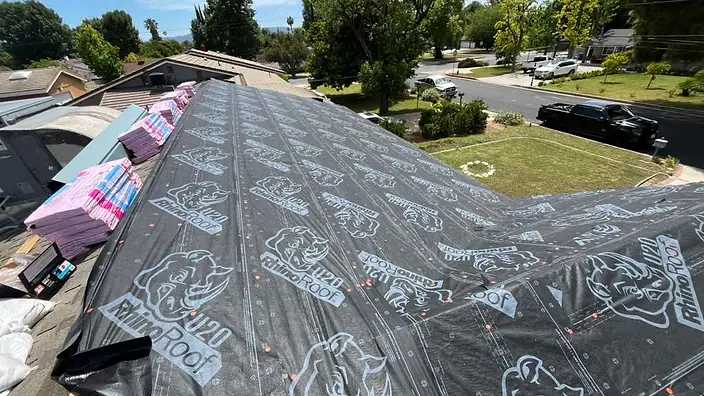 RhinoRoof underlayment fully installed on hip roof
Less than the material warranty implies. Intense UV, heat cycling and long dry spells followed by concentrated winter rain age roofing faster than in milder climates. Sun exposure, ventilation, color, slope and installation quality create large differences between two roofs of the same age on the same street.
Widespread curling, cupping or brittle shingles; significant granule loss showing as bald patches and sediment in gutters; leaks appearing in several unrelated areas; sagging planes; and soft or damaged sheathing found during inspection. Any of those point to a system at end of life rather than a defect worth patching.
Overlaying is sometimes permitted within limits, but it hides the condition of the deck and the underlayment — the two things most likely to be the actual problem — and it adds weight. Tearing off allows the deck to be inspected and repaired, and is generally the better long-term decision.
Roof replacement is permitted work in essentially every Los Angeles-area jurisdiction, and inspections may occur at tear-off and completion. Fire-zone requirements can also affect acceptable materials. Your licensed contractor should pull the permit under their license — not ask you to pull it as an owner-builder.
That pattern usually points to flashing, a valley, or wind-driven water rather than a hole in the field of the roof. Light rain drains normally; heavy or wind-driven rain gets under a flashing detail that only fails under pressure. It also means the leak path may be some distance from where the interior stain appears.
Tear-off and disposal, deck inspection with an allowance for damaged sheathing, underlayment specification, all flashing to be replaced (not reused), ventilation, the visible material, permit, and warranty terms for both labor and material. A quote listing only the shingle type is not a scope.
Tell us the property, the scope, and what matters most. Licensed California contractor · CSLB License #1104099.
 Outdoor LivingEditorial illustration
What drives deck cost in Los Angeles, how wood and composite really behave in intense sun, and which parts of a deck fail first.
 Gates & AccessEditorial illustration
Why automatic gates fail, how to tell a mechanical problem from an operator problem, the safety devices that must work, and a maintenance routine that prevents most calls.
 PlanningEditorial illustration
Fence costs in Los Angeles are driven by soil, slope, access, and structure — not just materials. Here's how to budget and compare bids accurately.