
Decks in Southern California: cost, materials and what actually wears out
What drives deck cost in Los Angeles, how wood and composite really behave in intense sun, and which parts of a deck fail first.
Exterior paint in Los Angeles almost never fails because of the coating. It fails because of what was underneath: chalked or unwashed surfaces, unrepaired stucco cracks, bare wood left unprimed, unaddressed moisture, or coating applied over a failing older layer. Preparation — washing, repair, priming and correct sequencing — is the majority of the labor on a properly run exterior job, and it is the part that decides whether the finish lasts five years or twelve.
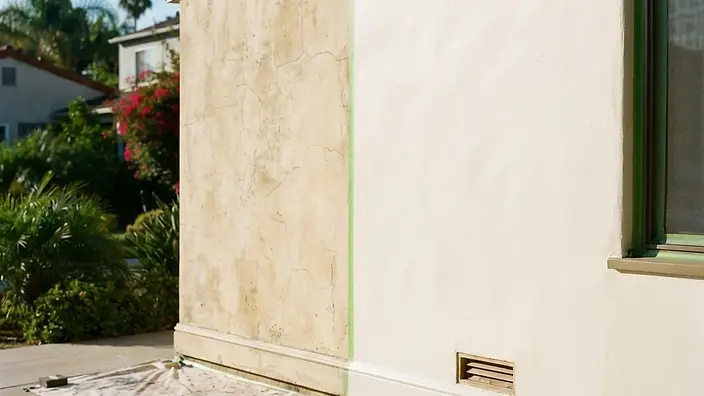 Editorial illustration — not a Fency Builders project. Surface repair, preparation and product selection belong in the same scope.
An exterior paint job is judged years later, and by then nobody remembers whether the walls were washed. That is the entire problem with how painting is bought: the visible product looks identical on day one whether the preparation took four days or four hours.
In Southern California the gap between those two jobs opens quickly. Ultraviolet exposure breaks down binders, daily heat cycling works every joint and crack, and the long dry season followed by concentrated winter rain finds every place where adhesion was compromised.
Common early coating failures include:
Note what is not on that list: paint brand. Product matters, but it is the last variable, not the first.
Stucco. Wash to remove chalk, dirt and biological growth. Identify cracks and treat them by category — hairline cracks bridged with an appropriate product; wider or stair-stepped cracks investigated first, because a moving crack is telling you about a structural or moisture condition that paint will not solve. Patch to match texture, which is craft work: a patch that reads as a smooth blob on a heavy texture is visible forever. Then prime the repairs.
Wood — siding, trim, fascia. Scrape failing coating, sand the edges so the transition does not telegraph, replace anything soft, prime every bare area, and caulk joints with a flexible sealant rated for exterior movement. Fascia and rake boards can receive concentrated sun and water exposure, so their condition should be assessed separately.
Metal — railings, gates, security bars. Remove rust to sound metal, prime with the correct primer for the substrate, then coat. Skipping the primer means the rust returns through the finish, usually within a season.
Previously coated elevations with heavy build-up. Sometimes the honest answer is that a failing multi-layer coating needs to come off in the affected areas rather than receive another layer.
The south and west elevations of a Los Angeles house live a different life than the north side. It is entirely normal for one elevation to need substantially more repair and to be the reason the whole house is being painted. A thoughtful scope reflects that rather than treating all four sides as one number.
The same applies to microclimate: coastal properties in Pacific Palisades and Playa del Rey face salt air and constant moisture, which changes both hardware corrosion and coating selection, while inland valley addresses like Valley Glen and Sun Valley face heat and sustained UV.
Paint is the last exterior trade. In order:
Painting before demolition, roofing, or adjoining construction can create avoidable rework. Where the whole exterior is being addressed at once, exterior painting should be sequenced with fence and gate, roofing, repairs, and hardscape for exactly this reason.
Ask for these in writing:
A bid that is a color and a price is not comparable to a bid that is a scope. If two numbers are far apart, the difference is often in preparation, repairs, access, product specification, exclusions, and measured area — and how to verify a contractor before you sign covers how to check that the lower number is a real scope rather than a shorter one.
Reviewed September 1, 2026. Rules and product requirements can change; confirm the parcel, approved documents, and selected system before relying on this guide.
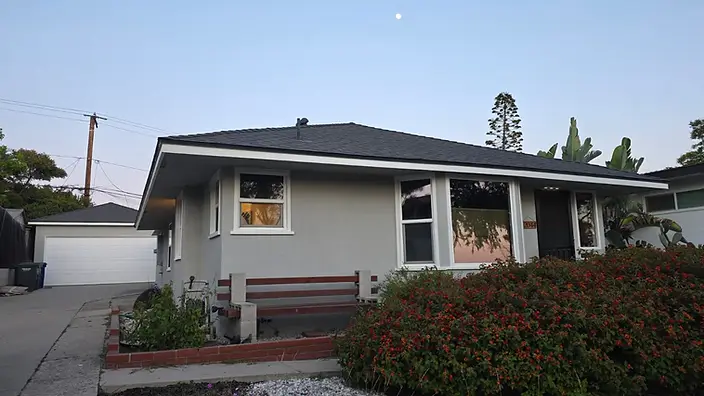 Fresh gray stucco exterior with white trim finish
It varies more by exposure than by calendar. South and west elevations take the most ultraviolet exposure and typically show fading, chalking and cracking years before shaded elevations. A well-prepared, properly coated exterior should give many years of service; a poorly prepared one can start failing within two.
Not successfully. Hairline cracks are repaired with an appropriate elastomeric or patching product, and larger or structural cracks need investigation before repair — a crack that is moving will reopen through any coating. Painting over the crack hides it until the next season.
Elastomeric is a thick, flexible coating that bridges hairline cracks and is common on stucco. It is a good tool in the right situation, but it is not a cure-all: it is heavier, it must be applied at the correct thickness, and applied over a damp or poorly prepared wall it can trap moisture. It should be a considered choice, not a default.
Two finish coats over correctly prepared and primed surfaces is standard. What matters more than the count is whether repairs were made, whether bare areas were primed, and whether the specified spread rate was achieved. Two thin coats sprayed quickly are not equal to two properly applied ones.
After. Roofing, stucco repair, carpentry, fence and railing installation all create damage or dust that a fresh finish will not survive. Paint is the last exterior trade for a reason, with only final touch-up after everything else is complete.
Surface preparation described specifically — washing method, scraping, sanding, crack and stucco repair, caulking, and priming of bare areas — plus the coating product and number of coats, which surfaces are included (body, trim, fascia, doors, garage, ironwork), masking and protection, and warranty terms. A one-line bid for a color change is not a scope.
Tell us the property, the scope, and what matters most.
 Outdoor LivingEditorial illustration
What drives deck cost in Los Angeles, how wood and composite really behave in intense sun, and which parts of a deck fail first.
 Gates & AccessEditorial illustration
Why automatic gates fail, how to tell a mechanical problem from an operator problem, the safety devices that must work, and a maintenance routine that prevents most calls.
 HiringEditorial illustration
The checks that take twenty minutes and protect the whole project: license status, insurance, contract terms, payment schedule and the warning signs.