
Decks in Southern California: cost, materials and what actually wears out
What drives deck cost in Los Angeles, how wood and composite really behave in intense sun, and which parts of a deck fail first.
Repair when the posts are sound and plumb and the damage is limited to panels, boards, rails or hardware. Replace when posts are rotted or moving, when more than roughly a third of the structure is failing, or when the fence is the wrong height or in the wrong place. Posts are the deciding factor: everything above them can be rebuilt, but a fence with failing posts will move again no matter what is attached to it.
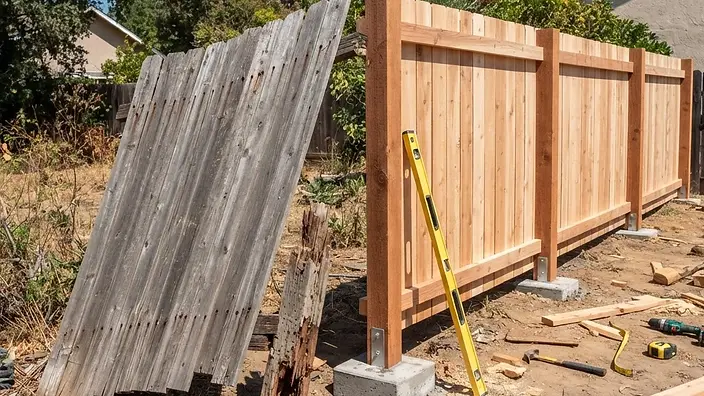 Editorial illustration — not a Fency Builders project. Post, footing, rail and panel condition determine whether repair is responsible.
Fence conditions often vary by run, post, gate, and exposure. One run leans, one section is fine, the gate drags, and two boards near the corner are soft. The decision that follows is worth getting right, because the common mistake — repairing enough to postpone the problem, then replacing the whole thing two years later — means paying for the fence twice.
Here is the inspection we walk with owners, and how to read what you find.
Everything above the post can be rebuilt. The post is the fence.
The push test. Take each post and push firmly at chest height. A sound post barely moves. Movement at ground level means the post or its footing has failed.
The probe test. At the soil line, press a screwdriver into the wood. Rot starts where wood meets soil and moisture, and progresses inward. A post can look perfect at the top and be hollow six inches below grade. On metal posts, check the same point for rust-through.
Look at the footing. Concrete that has cracked, heaved or was never there at all shows up as a post that rocks in its hole.
Record how many posts fail. That number, more than anything else, decides the outcome.
Repair when posts are sound and the failures are limited to panels, boards, rails and hardware.
Replace when:
Once repair work approaches a third of the run, the labor of demolition, matching, and returning for the next failure typically exceeds the cost of doing the run once and properly.
Replacing one run and keeping another is legitimate and often the best value. It works when the transition falls on a natural break — a corner, a gate, a change of grade or a change of material. It looks like a patch when it happens mid-run, because weathered and new material read as two different fences from the street.
On streets where the fence line is part of the block's character — Toluca Lake, Burbank, Pasadena — that transition point is worth choosing deliberately rather than stopping where the damage stopped.
A gate is a moving structure on two or three hinges, opened thousands of times. It fails before the fence does, and it fails at specific places:
Rehanging a sagging gate without addressing the post repeats the failure on schedule. On automated gates the stakes are higher, because the operator is forcing a leaf that is out of alignment — the mechanical side is covered in automatic driveway gates.
Position. Existing fences are frequently not on the property line. Rebuilding on an inherited mistake makes it your mistake. If the fence is a boundary fence, a survey before rebuilding is inexpensive relative to the alternative.
Height and rules. A fence built decades ago may not comply with current requirements, and replacement can be the moment those requirements apply. This is especially true where the fence sits on a wall or on a corner lot. The measurement rules and how to confirm them for your parcel are in fence and wall permits in Los Angeles.
Two decisions follow immediately: material and budget. Wood vs. composite vs. vinyl covers how each behaves in Southern California sun, and how to budget a new fence in Los Angeles covers the site conditions that move the number more than material choice does.
And whichever way the decision goes, the fix worth insisting on is the one underground: correctly sized, correctly depth footings on posts that are protected where they meet the soil. The written repair or replacement scope should identify post, footing, drainage, connection, and material conditions instead of addressing only the visible panel.
Reviewed September 1, 2026. Rules and product requirements can change; confirm the parcel, approved documents, and selected system before relying on this guide.
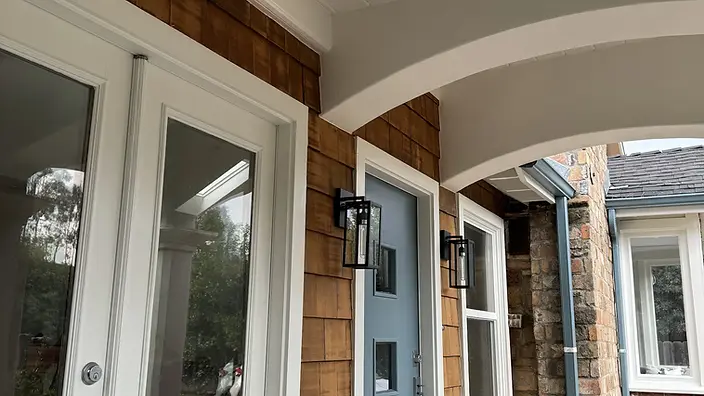 Horizontal wood slat privacy fence with metal posts
Grab each post and push firmly. Movement at ground level means the post or its footing has failed. Probe the wood at the soil line with a screwdriver — if it sinks in easily, the post is rotted where it matters even if the top looks sound. Metal posts should be checked at the same point for rust-through.
Sometimes. If the lean is from a single failed post or footing, that post can be replaced and the section reset. If several posts have moved, or the whole run has rotated, the structure has failed as a system and re-plumbing it is a temporary fix that usually reappears within a season or two.
Yes, when the posts are sound and the damage is limited to boards, rails, hardware or a small number of panels. It stops being worth it when repairs exceed roughly a third of the run, when the same section has been repaired before, or when the fence needs to be different in height or position anyway.
Yes, and it is often the right answer — replace the failed run, keep the sound one. It works best when the change happens at a natural break such as a corner, a gate or a change in grade. Mid-run transitions between old and new wood are visible for years because weathered and new material never match.
Gates carry a moving load on two hinges, so the gate post takes far more stress than a line post. A sagging gate usually traces to the gate post moving, an undersized post or footing, hinges too light for the leaf weight, or a frame that was never braced diagonally. Rehanging the gate without fixing the post repeats the failure.
Like-for-like repair at the same height and location is treated more simply than new construction in most jurisdictions, but it is not automatically exempt — particularly if the fence is over-height, sits on a wall, or the property is in a hillside, coastal or historic overlay. Confirm before starting, because the existing fence may predate the current rule.
Send the full fence line, the damaged area, and a close-up of the nearest post or connection. Include the city, material, and what changed. We’ll use that evidence to plan the sensible next conversation—repair, partial replacement, or a site review.
 Outdoor LivingEditorial illustration
What drives deck cost in Los Angeles, how wood and composite really behave in intense sun, and which parts of a deck fail first.
 Gates & AccessEditorial illustration
Why automatic gates fail, how to tell a mechanical problem from an operator problem, the safety devices that must work, and a maintenance routine that prevents most calls.
 PlanningEditorial illustration
Fence costs in Los Angeles are driven by soil, slope, access, and structure — not just materials. Here's how to budget and compare bids accurately.