
Decks in Southern California: cost, materials and what actually wears out
What drives deck cost in Los Angeles, how wood and composite really behave in intense sun, and which parts of a deck fail first.
The right automatic driveway gate type for a Los Angeles property depends on slope, available side-yard clearance, leaf weight, and local soil and wind conditions — not aesthetics alone. Swing gates suit level frontages with clear arc space, while slide gates handle slopes and tight lots but demand proper drainage and side-yard room. Either type outlasts its operator when the frame, posts, footings, and electrical work are specified correctly from the start.
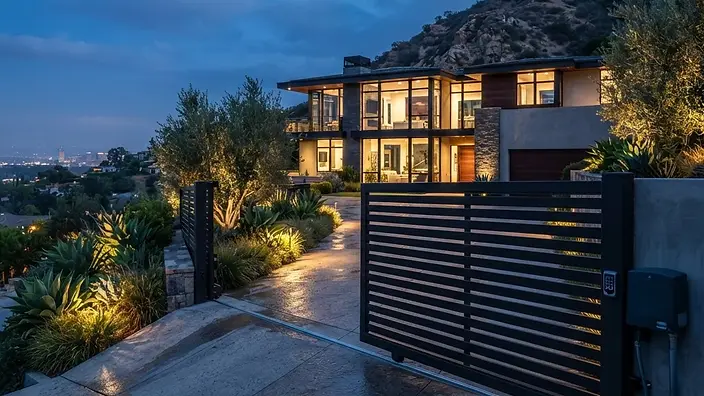 Editorial illustration — not a Fency Builders project. Driveway slope and side clearance choose the gate type before style does.
Choosing an automatic driveway gate in Los Angeles is not simply a decision about appearance. The lot grade, soil type, prevailing winds, utility layout, and local building department requirements all shape what you can actually build — and what will hold up over time without becoming a recurring service call.
Swing gates are one common residential choice in Los Angeles, and for understandable reasons: the mechanics are straightforward, the operator options are wide, and the finished look suits most frontages. A single-leaf swing gate pivots on two heavy-duty hinges attached to a post. A dual-leaf gate splits the opening down the middle, with each leaf swinging inward or outward.
The constraint that rules out swing on many LA lots is grade. If your driveway rises from the street — which is common on hillside properties in Silver Lake, Mount Washington, Laurel Canyon, or the Santa Monica Mountains — the rising leaf will drag or bind against the pavement before it reaches full travel. A slope of more than a few percent usually makes swing impractical without significant grading work. Confirm the acceptable range with your installer before committing.
Slide gates travel parallel to the fence line rather than swinging into the driveway or the street, making them the practical answer for sloped entries and short driveways. They come in two configurations: track-mounted, where rollers ride a ground-level rail, and cantilevered, where the gate is counterbalanced and clears the ground entirely. Cantilevered systems eliminate the ground rail — a meaningful advantage on driveways where debris, leaf litter, and the brief but intense Southern California rainstorms would otherwise pack the track and jam the rollers. Track systems are less expensive to build but require consistent drainage maintenance, especially during the dry season when decomposed granite, eucalyptus debris, and windblown soil accumulate fast.
Side-yard clearance is the non-negotiable constraint for slide gates. The required slide pocket, tail, hardware, and safety clearances depend on the selected gate and operator. Confirm the manufacturer's layout before fixing the opening or posts. Many LA infill lots simply do not have it.
A gate built for the Central Valley is not built for Los Angeles. The environmental conditions here are specific, and they affect material selection, footing depth, and operator sizing in ways a generic product catalog will not tell you.
Expansive clay soils are widespread across the LA Basin and hillside communities. Clay heaves when wet and shrinks when dry — and with Southern California's pattern of long dry periods followed by sudden heavy rain, that cycle is pronounced. Posts set in undersized footings will move. When a post moves, the geometry of the gate changes, and the operator works against a misaligned load. Footings need to be sized and reinforced for local soil conditions; confirm the specific requirement with your building department and a licensed contractor who has worked that soil before.
Santa Ana winds arrive seasonally and can drive sustained gusts that put enormous lateral load on a closed gate panel, particularly a solid-panel wood or composite gate. An operator rated only for the gate's weight without accounting for wind load will be working near its limit on a bad wind day. Specify an operator with a wind-load rating that reflects actual conditions, not a lab average.
Coastal salt air from the Pacific accelerates corrosion on exposed steel hardware — hinges, rollers, track sections, operator arms, and fasteners. Properties west of the 405 or near the beach face this more acutely, but salt air moves inland farther than most homeowners expect. Hardware selection and finish quality matter more the closer you are to the coast.
Seismic movement is a baseline reality, not a rare event. Small shifts — even imperceptible ones — gradually alter post alignment and gate geometry. Rigid, over-built connections that allow no flex can crack welds and stress hinges over time. Experienced LA contractors build in tolerances and specify hinge hardware rated for the gate's actual leaf weight, not approximate weight.
Wildfire defensible space and ember intrusion are increasingly relevant for properties in Very High Fire Hazard Severity Zones, which cover substantial portions of the hillside communities in the Santa Monica Mountains, Verdugo Hills, and the San Gabriel foothills. Confirm with your local fire authority whether your gate location and material choices are consistent with current defensible space guidelines. Solid wood panels may be treated differently than steel or aluminum under local requirements.
A gate proposal that only describes the panel is not a complete proposal. Every component below affects long-term performance, and omitting any of them from the written scope shifts the cost and the problem to you later.
This is one of the questions LA homeowners ask most often, and it deserves a direct, honest answer: it depends, and you need to confirm with your local building department before work begins. The City of Los Angeles, LA County unincorporated areas, and individual incorporated cities like Pasadena, Burbank, Culver City, and Santa Monica each administer their own codes. Height limits, setback requirements from the property line, permit thresholds, and HOA overlay rules vary. A gate that is permitted and code-compliant in one jurisdiction may require modifications in the next city over. A licensed contractor (look for a current CSLB license) can help you identify what questions to ask, but the definitive answers come from your local building and planning departments.
A gate diagnosis should not assume one cause. Frame and post movement, alignment, power, controls, safety devices, drainage, hardware, and the operator all require inspection.
A well-built frame on a properly sized post in an adequate footing will outlast multiple operator generations. The frame is not where driveway gate money is lost. The supporting specification is.
Ornamental steel is the structural default and holds up well with proper finish and annual inspection for rust at the welds and cut edges — the spots where coatings are thinnest. In coastal zones, hot-dip galvanizing or a powder coat rated for salt-air exposure extends service life meaningfully.
Wood or composite cladding on a steel frame delivers privacy and warmth without sacrificing structural reliability, provided the frame — not the cladding — carries the load. Wood cladding adds weight, which flows directly into operator and hinge requirements. Composite materials perform more predictably under UV and moisture cycling than natural wood.
Aluminum is lighter than steel, which reduces operator load on wide openings and is an advantage in coastal environments where corrosion is a persistent cost. It is less stiff than steel for a given section size, which matters on long spans.
Before you invite any contractor to price the work, write down your opening width, available side-yard clearance, driveway grade, whether a 120V circuit is accessible near the gate location, and your intended access control setup — keypad only, intercom, app-based, or a combination. Bring that information to the conversation.
A written estimate worth signing should itemize the frame specification, post and footing design, operator model and duty rating, safety device compliance method, access control components, electrical scope, and permit responsibility. Any proposal that groups all of this into a single line is not a scope — it is a number, and numbers without scope shift risk to you when something is missing. Ask what is excluded before you compare bids.
Reviewed September 1, 2026. Rules and product requirements can change; confirm the parcel, approved documents, and selected system before relying on this guide.
ASTM’s public catalog identifies the current standard; the complete standard is licensed separately.
 Horizontal wood slat privacy fence with metal posts
Permit requirements depend on your specific jurisdiction — the City of Los Angeles, LA County unincorporated areas, and incorporated cities like Pasadena or Santa Monica each have their own rules. Height, setback, and electrical permit thresholds can all trigger a requirement. Confirm the current rules with your local building and planning department before any work begins, and make sure permit responsibility is clearly assigned in your contractor agreement.
Generally, no — a driveway that rises from the street will cause the swing leaf to drag or bind against the pavement before it completes its arc. Even a moderate upward slope can rule out a swing gate without significant grading work. A slide gate, either track-mounted or cantilevered, is the practical alternative for sloped entries, provided you have adequate side-yard clearance.
Intermittent reversing or stopping is usually a sign that either the safety devices are triggering — photo eyes misaligned, a safety edge making contact, or a loop detector sensing incorrectly — or the operator is working against an obstruction like a dragging hinge, debris in the track, or post movement from soil shift. Both causes deserve a proper diagnostic rather than simply adjusting the operator's sensitivity setting, which can create an entrapment hazard if it masks a real safety device activation.
Operator lifespan depends more on whether it was correctly sized for the gate's actual leaf weight and duty cycle than on brand or model. An operator running near its rated limit in LA's heat — with added stress from Santa Ana wind loads and clay soil movement shifting the gate geometry — will fail significantly sooner than one with adequate headroom in its rating. Proper sizing at installation is the single largest factor in service life.
A track slide gate rides on rollers that travel along a ground-level rail, making it less expensive to build but vulnerable to debris and drainage problems — a real concern given Southern California's pattern of dry-season accumulation followed by sudden heavy rain. A cantilever slide gate is counterbalanced so it clears the ground entirely, eliminating the ground rail and the maintenance issues that come with it. Cantilever systems cost more upfront but are generally the better long-term choice for properties where debris management is difficult.
Send the driveway opening from inside the property, the approach and slope, available side clearance, nearby power, and the city. We’ll use those facts to decide whether a swing or slide concept deserves a site assessment.
 Outdoor LivingEditorial illustration
What drives deck cost in Los Angeles, how wood and composite really behave in intense sun, and which parts of a deck fail first.
 Gates & AccessEditorial illustration
Why automatic gates fail, how to tell a mechanical problem from an operator problem, the safety devices that must work, and a maintenance routine that prevents most calls.
 PlanningEditorial illustration
Fence costs in Los Angeles are driven by soil, slope, access, and structure — not just materials. Here's how to budget and compare bids accurately.